a

Swiss Internet Initiative: Would Art. 93a cause problems for the Fediverse (in CH)?

In Switzerland, signatures are currently being collected to get a popular initiative off the ground that would anchor the protection of fundamental rights and democracy in the digital space in the Federal Constitution.
At first glance, the initiative sounds good and sensible to me personally. But I wonder:
To what extent would the legal article below cause problems for the Fediverse?

Initiative’s website: https://www.internet-initiative.ch/initiative/

The initiative text, translated into English:

Federal popular initiative “For the Protection of Fundamental Rights and Democracy in the Digital Space (Internet Initiative)”
The Federal Constitution is amended as follows:
Art. 93a Protection in the digital space

The Confederation shall enact provisions on the protection of fundamental rights and of democratic decision-making processes in the digital space.
It shall oblige providers of communication platforms and search engines, as well as providers that generate content by means of automated or artificial-intelligence-based systems:
a. to protect people from violations of their fundamental rights;
b. to prevent the dissemination of content that contains sexualised violence, incites violence, or glorifies violence;
c. to limit systemic risks with regard to the manipulation of democratic decision-making processes, in particular through disinformation or algorithmic amplification;
d. to protect the population from cybercrime.
Providers shall be obliged to examine, free of charge, reports of violations of their obligations under paragraph 2, to take the necessary countermeasures, and to report publicly on this. The Confederation shall regulate the procedures and the supervision of providers.

2026 - 43 : Let's explore the fediverse 🤓

Piefed chat • Fediverse wiki
• Guide and tutorial


!communitypromo@lemmy.ca • !newcommunities@lemmy.world • !fedigrow@lemmy.zip • !newcomers@piefed.zip

Hi ! I hope you are well ! Here is our weekly thread 😎

The fediverse is big ! Let’s share our small gold nugget found in the fediverse. :)

It could be :

  • A new peertube channel
  • An interesting mastodon account to follow
  • Your new community ! Yes ! Why not ?
  • An cool gallery of picture from pixelfed
  • A playlist from funkwhale
  • A text that moved you

Let’s dig together ! 😁

The Relational Origins of Rules in Online Communities

Linked to https://dl.acm.org/doi/full/10.1145/3817015

Where do rules come from in online communities? This study investigates how and why online communities adopt and change their rules. We conducted a grounded theory-based analysis of 40 in-depth interviews with community leaders from subreddits, Fandom wikis, and Fediverse servers, and identified seven processes involved in the adoption of online community rules. Our findings reveal that, beyond operational reasons like regulating behavior and solving problems, rules are also adopted and changed for relational reasons, such as signaling or reinforcing community legitimacy and identity to other communities. While rule change was often prompted by challenges during community growth or decline, change also depended on volunteer leaders’ work capacity, the presence of member feedback mechanisms, and relational dynamics between leaders and members. Our findings extend prior theories from social computing and organizational research, illustrating how institutionalist and ecological explanations of the relational origins of rules complement operational accounts. Finally, we build on these explanations to offer a set of design propositions that reflect the relational aspects of rules and rulemaking across communities’ lifecycles.

…

Although leaders often adopt rules to regulate behavior and content, we find that this is only part of the story. Rules also reinforce a community’s distinctive identity within an online platform and establish a community’s legitimacy in broader networks. This insight complements and challenges prior operational accounts of the sources and purposes of rules in social computing work, from both social engineering and community governance perspectives, and reveals underappreciated relational aspects of rulemaking. Some of these relational aspects are external, such as when rules draw distinctions or signal alignments between communities. Others are internal, as when rules reinforce identity or consensus among a community’s leadership team or between leaders and regular members.

Both internal and external relationships are important in the processes of rulemaking; they draw attention to problems, help form solutions, and shape decisions about changing the rules. Our work also extends prior quantitative research in CSCW on changes in community rules [31, 74] by showing how leaders think about rule creation and change, as well as how different community platforms may shape rulemaking processes by constraining relations in different ways.

In the rest of our Discussion, we consider the implications of relational dynamics of rules in governance systems for online communities. We then reflect on how our findings inform theories of institutional design and change in online communities as well as directions for future research on community governance. Along the way, we highlight a set of design propositions that suggest future work—both system building as well as empirical evaluation—derived from a more relational understanding of online community rules. We present these as tentative propositions for future design and evaluation work to illustrate the applicability of our theoretical framework, rather than as definitively proven guidelines.

…

A prevailing assumption in prior scholarship is that rules formalize social norms that regulate interactions within communities [9, 16, 36, 56, 77]. Rules are treated as instruments for directing human interactions in computer-mediated environments. We find that, in addition to advancing this operational purpose, rules also serve relational purposes as leaders design rules with respect to other communities, leaders, and users.

First, rules set and sustain community boundaries, particularly to protect community identity amid evolving membership dynamics. The challenge of protecting identity is important—particularly for communities prone to influxes of new members who may alter the community’s composition or undermine its focus [60]. In response, communities discoverable on large platforms and open to broad participation often implement rules that restrict off-topic content. While prior work has suggested that rules contribute to identity formation [9, 28, 81], our findings show that communities may defend their identity over time by prescribing strict guidelines for participation, often through reference to related communities. We extend prior work by Hwang and Foote [44] and TeBlunthuis et al. [89] who emphasize the importance of membership size and niche audiences within ecosystems of interdependent communities. This relational use of rules helps explain the concept of “nested niches,” in which communities thrive through their embeddedness in a broader socio-informational ecosystem [44]. Rules may provide tools for drawing and maintaining boundaries between specialist and generalist spaces—especially on platforms, such as Reddit, where communities often emerge from one another and share overlapping members and topics [85, 86, 87].

A pretty refreshing look at how communities form and establish boundaries, and it features the Fediverse too! I think what makes this a good fit for this community is that it is easy to flatten and invisibilize dynamics this paper captures beautifully and brings to the forefront.

Understanding Community-Level Blocklists in Decentralized Social Media

Linked to https://dl.acm.org/doi/10.1145/3817026

In The Open Society and Its Enemies [53], philosopher Karl Popper introduces the “paradox of tolerance:” unlimited tolerance can undermine itself by allowing intolerance to flourish. This philosophical insight highlights an ongoing challenge for online communities: determining which behaviors to accept and which to reject to maintain inclusive and civil discourse.

Online communities operationalize this principle through content moderation, the process of shaping information exchange and user activity by deciding upon and filtering posted content according to established rules [30, 42, 68]. In centralized social media like Facebook [20] and Reddit [17], previous studies have examined content moderation practices at three levels: platform [17, 28, 55], community [33, 35, 60], and personal [20, 37]. However, these studies predominantly reflect centralized contexts, leaving significant gaps in understanding moderation within decentralized platforms, where even the very notion of a “platform” is contested.

Decentralized systems are built based on “protocols” that define standards for building interoperable digital infrastructure [49]. Consider, for example, Mastodon [4], a widely used open-source software implementation of the ActivityPub protocol [63]. Mastodon is a decentralized alternative to mainstream centralized social media platforms like X. With Mastodon, people can create or join independently operated servers commonly referred to as “instances” (e.g., mastodon.social, mstdn.party), which are part of the “Fediverse.”

The Fediverse refers to the network of thousands of such instances running Mastodon and other ActivityPub implementations. And the process of peering between instances to allow information exchange in the Fediverse is referred to as federation [9]. Instances can interact with one another through the ActivityPub protocol. However, each instance in the Fediverse is independently administered by a user or group who sets local rules and moderation policies, effectively functioning as a self-governed online community. This independence allows communities to reflect local values but also creates challenges around consistency and coordination across instances [9, 21, 32, 34, 56].

A key moderation mechanism available to Mastodon instances to moderate cross-instance interactions is community-level blocklists. This allows the moderators of an instance to block entire instances of users they believe are problematic [14, 19]. These decisions can completely shape the experience of their own users. For example, if the instance users reside in blocks or are blocked by the most popular instances, they would be cut from a broad swathe of content and interactions in the Fediverse.

Prior work has examined blocklists at the personal level — when individuals use them to block other individuals — on centralized platforms, noting their potential for collective action [26] as well as individuals’ contestation of harassment [37]. In comparison, decentralized systems enable community-level blocklists, which both constrain who makes blocking decisions (only the instance admins) and expand the scale of the decision’s impact (everyone in the instance). Prior work already highlights concerns about transparency [40] and democratic decision-making by communities in online spaces [57]. As social media systems like Mastodon become more widely adopted [46, 69], understanding blocklists in this context is crucial for improving content moderation in decentralized settings. However, despite their prominence, little is known about how Mastodon moderators currently manage these blocklists, what tools they use, and what additional support they need.

…

Summary of Results. We found that existing blocklists and tools differ substantially in their purposes, inclusion criteria, transparency, and accountability. Some prioritize broad consensus across instances, while others focus on severity-based or manual curation (RQ1). Through interviews, we identified how moderation styles shape the understanding and usage of blocklists. Different styles embody different trade-offs of how open, safe, and context-specific moderation should be (RQ2). Finally, we identify several avenues for improvement in the design of blocklist tools, including category filters, severity toggles, comment receipts, and collaborative moderation features (RQ3).

A sort of twin of the other paper I just posted about the Fediverse, but focused on blocklists rather than the process of making rules.

All of this is still so new (and kind of really old too) and that makes this kind of work super important. Definitely check this paper out!

2026 - 42 : Let's explore the fediverse 🤓

Piefed chat • Fediverse wiki
• Guide and tutorial


!communitypromo@lemmy.ca • !newcommunities@lemmy.world • !fedigrow@lemmy.zip • !newcomers@piefed.zip

Hi ! I hope you are well ! Here is our weekly thread 😎

The fediverse is big ! Let’s share our small gold nugget found in the fediverse. :)

It could be :

  • A new peertube channel
  • An interesting mastodon account to follow
  • Your new community ! Yes ! Why not ?
  • An cool gallery of picture from pixelfed
  • A playlist from funkwhale
  • A text that moved you

Let’s dig together ! 😁

FediForum | Creative Commons Licence

Linked to https://fediforum.org/2026-10/session/1-d/

Links

Links:

Note

Pixelfed now includes the ability to add a CC-License to your account. CC was created in the early 2000’s based on the concerns people had at that time about content use. In 2026, there are other concerns about content reuse (such as for having their content included as training data for an LLM), which are not indicated by CC-Licensing. Courtney mentions “Really Simple Licensing”: https://rslstandard.org/ - this provides a way to make assertions about content blocks on your website including for LLM scraping. […]

FediForum | Fediponics: Automated Bot Detection and Moderation for Mastodon Instance Administrators

Linked to https://peertube.wtf/videos/watch/5fc0acb4-3754-4fb4-bd49-4f3cd525cd05

PS : And Piefed already achieve most of these. :)

How it works ?

1) New accounts are scanned automatically

The scanner runs on a configurable interval or in real time via Mastodon webhooks, checking new signups as they arrive.

2) A risk score is assigned based on 70+ signals

Username patterns, email analysis, profile completeness, signup timing, IP reputation, and more are each weighted and summed into a 0–100 score.

3) Actions are applied based on configurable thresholds

Accounts that cross your thresholds are automatically silenced, frozen, or suspended — no manual review needed for obvious bots.

What gets checked ?

Each signal adds points to the account’s risk score. You can enable or disable any signal.

👤 Username

  • Suspicious character patterns
  • Excessive numeric suffixes
  • Known bot naming conventions

✉️ Email

  • Disposable email providers
  • Suspicious TLD patterns
  • Commercial & payment domains

🪪 Profile

  • Missing avatar or header
  • Empty bio
  • No posts after signup

🕐 Timing

  • Late-night signups (1am–6am)
  • Configurable timezone

🔍 IPQualityScore (optional API key)

Email fraud score

  • Honeypot / spam trap
  • Disposable email (IPQS)
  • Recent email abuse

IP fraud score

  • VPN / proxy detection
  • Bot activity flag
  • Recent IP abuse

Scoring system : customizable rules

Every aspect of the scoring system can be tuned to fit your community’s needs.
⚖️

Action thresholds

Set independent score cutoffs for silence/limit, freeze, and suspend. Accounts scoring below all thresholds are left alone.
🎛️

Per-signal weights and toggles

Enable or disable any individual check. Adjust score weights so signals that matter more to your instance have greater impact.
📋

Custom domain & keyword lists

Maintain your own lists of suspicious TLDs, commercial domain keywords, and payment processor domains used in email addresses.
🔬

Dry-run mode

Preview exactly which accounts would be actioned and why, without making any changes. Tune your rules until you’re confident, then go live.
⏱️

Flexible trigger modes

Run on a scheduled interval to catch up on recent signups, or use Mastodon’s account.created webhook for real-time scanning the moment an account is created.

⚠️ We recently released # PeerTube v8

Linked to https://github.com/Chocobozzz/PeerTube/releases/tag/v8.3.1

⚠️ We recently released #PeerTube v8.3.1, which fixed several security issues. The full changelog is now available. If you haven’t done so already, please upgrade your platform as soon as possible!

SECURITY

  • critical Fix potential XSS with remote storyboard in SVG format GHSA-jwcf-xj6w-xqm5
  • high Do not allow moderators to act on 2FA/token sessions of other moderators/admins GHSA-xpw4-mxj2-rj8x
  • moderate Prevent private video metadata leak GHSA-4hwq-4jr6-w3gg
  • moderate Prevent ActivityPub DDOS GHSA-r8wm-f869-fpw3
  • moderate Fix SSRF for webfinger, HTTP video import and JSON-LD context resolver GHSA-xgcr-r7cv-7xhv
  • Security hardening

Bug fixes

  • Force video encoding if there are rotation info
  • Fix broken studio on only intro/outro/cut task
  • Fix broken sorts/invalid sort checkers for channel syncs and ownership changes
  • Fix downloading a download-protected video for admins
  • Fix broken email title in some emails
  • Fix broken notification window if the list contains a broken change ownership notification
  • Fix table pagination after a search
  • Include muted muted videos when admins/moderators display all videos of an account/channel

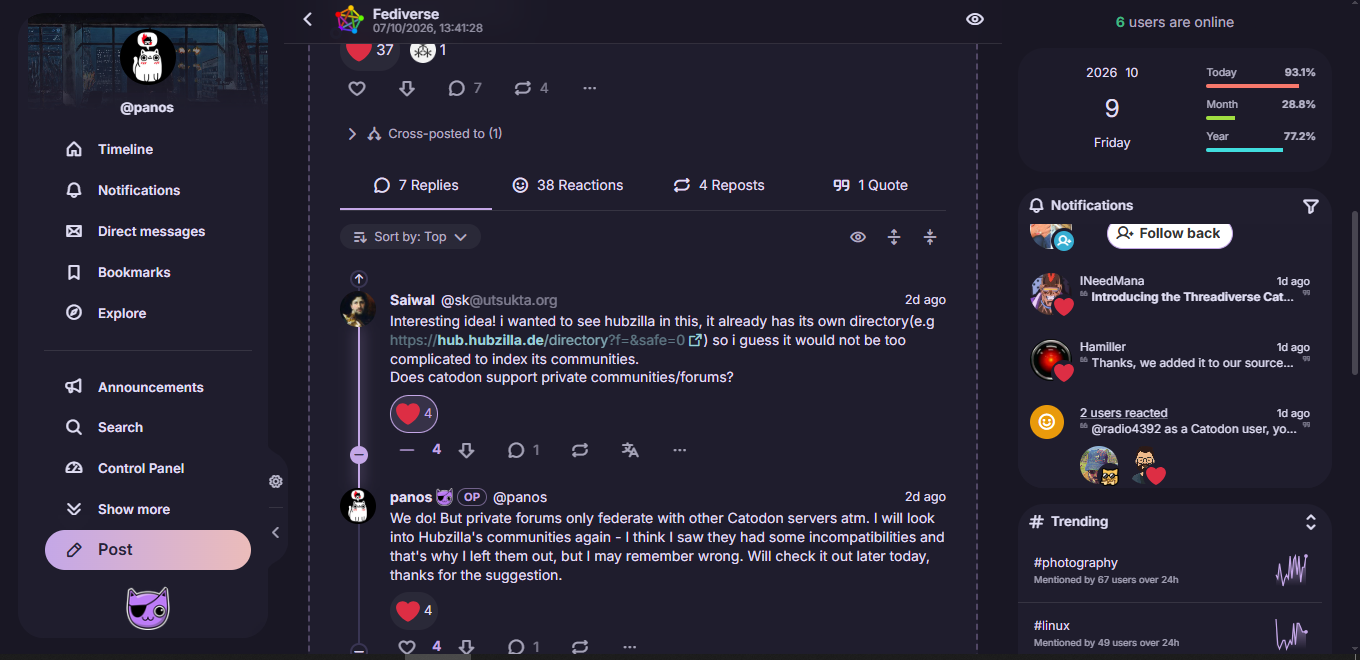
Thread view redesign in Catodon

Today I merged many UI changes, mostly around how threads are viewed and navigated.

I took some of the good elements of Reddit, so now we have sorting by Old/New/Top (the default for the microblogging timelines is Old, and for forums it’s Top - both can change in settings) and a flexible replies section with collapsible/expandable branches.

Top-level posts now show the total number of replies under the whole thread, not just the direct/first level replies (but again you can change it back in Settings). I also saved much vertical space, so now you can read long threads with less scrolling.

If I may say so myself, I honestly believe it’s one of the best UIs on fedi, especially for reading conversations. I think that if anyone tried it, they would agree. Really, really happy with the results. It’s still fresh, so I will probably refine things here and there, but it’s pretty much exactly as I envisioned it.

Let us know what you think!

#catodon

[v1.11.0] Block instances, further improve the UI of feeds, bugfixes and more

Linked to https://github.com/MbinOrg/mbin/releases/tag/v1.11.0

Crossposted from https://fedia.io/m/mbinReleases@gehirneimer.de/t/4440654

After quite some slow development, finally we can release a new version of Mbin. It contains new features for users, performance improvements and important security fixes.

Summary for Users

  • Show who boosted content in the feed (Combined view + subscribed + newest)
  • Add ability to block instances. Content from blocked instances will not show up in the feed and search anymore.
  • Fix emoji autocomplete inserts ’null’
  • Show a placeholder when an image embed could not be loaded
  • Improve design of posts and comments in some areas of the site
  • Fix endless loop when compressing uploaded images
  • Fix layout when a comment contains a very wide table
  • Bugfixes for some federation issues (handling of Mastodon posts with multiple images, embedded video formats, buggy mentions, etc.)
  • Change layout of list of cross posts
  • Fix the issue of browsers wanting to download a file when unsupported media files are used in an embed
  • Add translation for Swedish (by Jonatan Nyberg)

Summary for Server Admins

  • Minimum software requirements updated to PHP 8.5, Node 24 and Ubuntu 24.04 recommended
  • Upgraded most of our dependencies. For more details see #2162
  • Add ability to block instances globally.
  • Instances blocked this way will be blocked for all current and new users. Users can unblock them manually afterward; thus allowing a “soft” way to moderate the content shown by default for your users. For more details see #2155
  • Added the new queue async_slow for long-running tasks. If your async queue have gotten full often in the past, consider creating a separate messenger for async_slow.
  • The sessions are now stored in Redis instead of Postgres. You need to enable persistence in your Redis server, if you want to keep open sessions on restarts of Redis.
  • Fixed a couple of security vulnerabilities
    PostgreSQL autovacuum is tuned for high-churn tables

Summary for developers

Mbin:

  • Minimum software requirements updated to PHP 8.5 and Node 24
  • Upgraded most of our dependencies. For more details, including possible breaking package changes, see #2162

Fediverse:

Fix issue that to value might be an object instead of array in some edge-cases

Upgrade Instructions

There are significant changes in the DB. It is advised to create a DB backup before upgrading.

After the post-upgrade script has run, you should not clear Redis / Valkey.

For Docker

  • Get the official image or checkout the code and build it locally
  • Stop all containers docker compose down
  • Start all containers docker compose up -d

For Bare Metal

  • Ensure you have PHP 8.5 and Node 24 installed
  • Login as the mbin/kbin user: su mbin
  • Go to your repo cd /var/www/mbin
  • Get the new release: git fetch && git checkout v1.11.0
  • Run the update script: bash bin/post-upgrade
  • Run exit so we are back at the root user (or put a sudo in front of every command)
  • Clear your opcache by reloading php fpm systemctl restart php8.5-fpm
  • Restart the messengers: supervisorctl restart messenger:*

2026 - 41 : Let's explore the fediverse 🤓

Piefed chat • Fediverse wiki
• Guide and tutorial


!communitypromo@lemmy.ca • !newcommunities@lemmy.world • !fedigrow@lemmy.zip • !newcomers@piefed.zip

Hi ! I hope you are well ! Here is our weekly thread 😎

The fediverse is big ! Let’s share our small gold nugget found in the fediverse. :)

It could be :

  • A new peertube channel
  • An interesting mastodon account to follow
  • Your new community ! Yes ! Why not ?
  • An cool gallery of picture from pixelfed
  • A playlist from funkwhale
  • A text that moved you

Let’s dig together ! 😁

Catodon 26.10.0 "Bongo Cat" released!

Linked to https://codefloe.com/catodon/catodon/releases/tag/26.10.0

This is a big one! Caught up with Misskey 2026.10.0, added ActivityPub C2S API support (we know there are not many clients, but we want to do our part for standardization in the Fediverse), added post languages and language filters, replaced Redis with Valkey and many more…

Read the release notes for a full list of everything we did this month!

Here is a lenghty part of the changelog, click on the link for the full version

changelog

The project is now a Misskey fork

  • Dependencies brought up to current Misskey. Backend dependencies were brought up to the versions Misskey runs in one sweep, including the AWS S3 client
  • Many Misskey features merged since the last Sharkey stable
  • A Misskey server can move to Catodon directly
  • The MFM parser was updated and patched to read emoji up to Unicode 17.0

Forum & Federation

  • Forum discovery through the Threadiverse Catalog.
  • A Lemmy-compatible API that lists this server’s public forums (/api/v3/community/list, /api/v3/community, /api/v3/site)
  • Cross-posting in forums. A topic posted to several forums is published once and cross-posted to the rest
  • Blocking a server, as its own thing beside the server mute. It removes the follows in both directions
  • An ActivityPub client API (client-to-server), so ActivityPub apps can sign in and post, read, follow, react, upload and more.
  • Reduced-relationship notices. When a moderator blocks a whole server, affected accounts are told which server and how many relationships in each direction it covered, served natively and as Mastodon’s severed_relationships

Mastodon

  • Word mutes become Mastodon filters. /api/v1/filters and /api/v2/filters
    read and write the same filters the settings screen does

  • Security and correctness ports from Misskey 2026.10.0

  • Familiar followers (accounts/familiar_followers) and a native
    users/familiar-followers, with the privacy rules Mastodon applies.

  • POST /api/v1/statuses/:id/translate, configuration.translation.enabled
    and /api/v1/instance/translation_languages, so Mastodon apps (Tusky, Moshidon, the official Android app) offer translation

  • Bookmarks and blocked domains can be imported

  • Lists can be exclusive over the API, matching the native “Hide from home timeline” switch.
  • A post’s language is now reported and accepted
  • Smaller parity fixes

Posts, timelines and media

  • Like and repost counts that match the origin. Popular posts from Mastodon
    show the counts Mastodon states

  • Trending links, server side. Mastodon-style link trends with moderator review

  • “Also discussed in”. Posts sharing a link now list the other posts discussing it, forum topics first
  • Watching a post or a thread, with its own notification type and grouped notifications for busy threads.
  • A focal point on images, honoured by every crop the client makes and
    federated as Mastodon’s toot:focalPoint

  • Language filtering for timelines, with a per-timeline Show all languages override, plus per-post languages and a language pill in the composer.

  • Hot was reworked so likes and votes carry more weight against age, and no longer lets forum posts crowd out Home, Social, Media, Local and Global.
  • Double-tap media to like straight from the Media timeline, in the grid and immersive layouts.
  • Grid and immersive layouts for custom feed tabs, and an Options menu on list and custom feed tabs.
  • Hide URL previews entirely, a device setting under Settings > Posts and reactions.
  • A landing page setting deciding what signed-out visitors see at the root.
  • RSS, Atom and JSON feeds for hashtags (/tags/:tag.rss, .atom, .json).

Moderation

  • Freeze an account. stop it signing in or acting on any path, with its profile and posts left in place. Suspension is still what takes an account out of view.
  • IP address and range blocking in Control Panel
  • An email domain can be held for approval instead of refused outright.
  • A role can require two-factor authentication, the base role included.
  • Announcements can be sent by email to every eligible local account, in resumable background batches.
  • Moderators are notified in-app when someone files a report or signs up, as
    Mastodon’s admin.report and admin.sign_up.

  • Reports carry what the reporter chose : category, rules and attached
    posts…and can be forwarded anonymously.

  • Database connection pool logging, so db.extra.max can be set from evidence rather than guessed.

​:catodon:​ #catodon

Introducing the Threadiverse Catalog

Linked to https://catalog.catodon.rocks/

I'm the maintainer of Catodon, which offers both microblogging and forums (Lemmy-compatible communities), and we noticed that discoverability is not the threadiverse's strongest point: Our server only showed forums/communities that it "knew" because someone from the server already followed them. In Reddit it's easy to see if there is a community for a subject you care about; on the Fediverse it's not that easy.

So I looked at what indexes there are, and most were focused in Lemmy - lemmyverse.net has added MBin and PieFed explorers, but I was looking for something that covers more platforms, and is a unified directory, rather than per-platform only. Maybe there is something that I missed, but I didn't find what I was looking for: a directory for the threadiverse. So I decided to build it.

The Threadiverse Catalog lists forums/communities from Catodon, Discourse, Friendica, Lemmy, Mbin, Mobilizon, NodeBB and PieFed. It hasn't been online for many days, so it hasn't indexed everything, but we already list over 20.000 forums/communities. If there are any bugs or other issues, please let me know.

We built this primarily for Catodon, and on our latest release (26.10.0 "Bongo Cat") users have access to its results through the in-app Search and Explore features, but it's open for everyone to use. It's open source and written in Go. Other projects are also welcome to use it.

Cheers =)

#threadiverse #fediverse #catodon #discourse #friendica #lemmy #mbin #mobilizon #nodebb #piefed

Introducing Fedizen, Our Bonfire Project

Linked to https://wedistribute.org/2026/10/introducing-fedizen-our-bonfire-project/

We Distribute is teaming up with Bonfire to develop a new kind of social instance - one that elevates curation and discovery to promote all things Fediverse. It’s a social instance, but also a discovery portal.

Fedizen is a collaborative effort between ourselves and the Bonfire team to build a new kind of Fediverse instance, one built specifically for the network and the communities growing around it. It combines ActivityPub federation with curated aggregation to create a network-wide community portal

In a nutshell, Fedizen is almost like a grassroots approach to building Yahoo, but designed specifically to serve the space. It’s an effort to collect all of the news coverage, community opinions, development blogs, events, and media, and put it into one place that’s easy to find, easy to filter, and adjusts based on what you’re most interested in within this space.

epsilon.social a fork of mastodon that use AI for moderation process

I don’t know what to think about it.

When you use a free software, don’t mention it

https://epsilon.social/about

First, they completly hide the fact that it is based on Mastodon in their main page. You have to check their source code where they explain technical detail about their fork.

Epsilon is a French social network built on Mastodon. It is a fork of Mastodon v4.6.0 that adds content categorization, AI-assisted moderation, and a complete redesign of the web interface.

I think Mastodon developers deserve a little more love and credit.

AI moderation

Then, they openly admit that they use AI for moderation and probably Claude. I should warmly thank them for their transparency :

Human moderation

Moderation happens before publishing: every post is first checked by AI. Sensitive content, cases where the AI is unsure, and anything flagged go through human review.

If it is “human moderation”, then every post shouldn’t be checked by the AI, isn’t it ? We know and hear everytime that “we lack people”, “we just execute some script that make our life easier”. But, AI, no thank you.

We recently have a post from an user that used AI for reviving a dead project, Castodon, that he loved. He finally found some dev help. But, for me, that’s another scale from analysing every posts we made by an AI.

Can we review its code inside the blackbox ?

I not doing moderation, i also build a para-social relationship with you, good or bad. Sometime i post, sometime i intervene, sometime i protect myself, sometime i talk about myself. I’m an user that do moderation and animate communities in the fediverse. That maybe the huge difference between creating a community and using a tool for mass moderation process.

Another problem remain, and that’s the exact same reason we blocked Threads (Meta) : if we interact with epsilon.social users, our com will be probably analysed by the AI.

Privacy policy

https://epsilon.social/privacy-policy

According to their privacy policy, they claim that 3 principles governe their project :

Trois principes gouvernent l’ensemble. Nous ne vendons ni ne louons aucune donnée personnelle. Nous ne pratiquons aucune publicité fondée sur le profilage de votre comportement. Nous n’utilisons pas vos contenus pour entraîner des modèles d’intelligence artificielle.

Quick translation :

  • They don’t sell nor rent any personal data
  • They don’t use tracking ads based on our profil behaviour
  • They don’t use your data to train AI

They will probably apply it for the time being. How long ? How many time have we seen privacy policy change on a service provider ?

The good side, for european citizen, is that they are on an european tech stack and GDPR compliant. That’s a good thinking for european sovereinety and thus limited by european sphere. But the question is : Can you trust it ? It is directly feed to an AI anyway. We will never know where our data will go, except some promises written on a web page.

https://github.com/epsilon-social/epsilon/tree/epsilon-v0.3.24

The code source mention that they use mistral for moderation process.

Personal opinion

Honnestly, i can’t trust them.

At this point, I would rather trust my own server, some friend or my local association that endorse free software for years.

I think, as we did for Threads (meta, facebook…) the safest option is to defederate or block their domain epsilon.social